
Elaris · Chapter V
The Gate Without a Shadow
Your place and text size are remembered in this browser.
Scene I
What Rhaevan liked best was the brief moment when the people in his bed forgot he was king.
This time it lasted less than a minute.
All four of them were naked. The fire was dying behind the iron grate, leaving uneven bands of light across their bodies. The bed curtains muffled the crackle of wood and shut out the palace, the guards at the door and the hundreds of people sleeping beneath a roof that belonged to Rhaevan.
Daylight showed at the edges of the curtains.
The woman knelt between him and the dark-haired man. One hand rested at the back of the king’s neck, the other on her companion’s chest. Both men held her by the hips. Her skin was slick with juniper oil; her hair lay loose over her shoulders, clinging to her neck and lips.
She moved to a rhythm Rhaevan made no attempt to dictate.
At first.
When she slowed, his fingers tightened on her hip. She answered with a glance over her shoulder, too bold for a subject and desired for that very reason. A thin white scar ran along the inside of her wrist. Rhaevan had asked about it twice. Each time she had told him a different story.
She slipped her fingers into his damp hair and drew him into a kiss. She sat on him without asking, leaving no room for ceremonial distance or for waiting until a nod gave permission.
The dark-haired man tipped his head back. She pressed her back against his chest as his hands moved over her waist. His eyes were closed, his lips parted. Each movement of hers left him breathless, and he made no attempt to hide it.
The fair-haired man lay behind Rhaevan, propped against the headboard. He had slid one leg between the king’s thighs. His mouth travelled from the nape of Rhaevan’s neck towards his jaw, patiently finding the places where the king’s body responded before his face did.
He smelt of wine, smoke and the same oil he had rubbed into his hands earlier.
He bit Rhaevan just below the ear.
The king drew breath. His hand closed on the man’s thigh so hard that pale marks remained beneath his fingers.
The fair-haired man laughed softly.
“Does it hurt?”
“Not yet.”
Teeth touched skin again. Harder this time.
Rhaevan did not turn his head away. He let the man leave a mark he would have to conceal beneath a high collar at the audience. In a few hours, dignitaries would bow their heads before him. None would guess what the king was hiding beneath his ceremonial clothes.
The woman made a low, stifled sound. Rhaevan moved his hand across her belly. She found it and guided it lower.
She stopped it only where she wanted it.
The dark-haired man opened his eyes.
He looked at Rhaevan calmly, almost sadly. For a moment the king thought he saw his own face as it had been years ago, before he had learnt to answer every question with the expression of a man who already knew the outcome.
The woman took the dark-haired man by the chin and kissed him. Rhaevan drew them both closer until there was no space between them for the cool air.
The fair-haired man moved his lips down the king’s neck. Lower. He stopped and looked up.
Rhaevan laid a hand on the back of his neck.
The man understood.
The king’s breath faltered. When he shifted position, pain shot through his bad knee. The woman felt him flinch but did not slow. She moved her hand along his thigh and held the taut muscle, knowing without asking where it hurt.
She smiled against his cheek.
“Your Majesty.”
Rhaevan caught her hair and tilted her head back.
“Not here.”
Her smile remained.
“Then who are you?”
The question struck deeper than it should have.
Rhaevan’s fingers loosened in her hair. For a heartbeat he lost the rhythm. She had to brace a hand against his chest to keep her balance.
She felt it. She did not laugh. She watched him from close by, still waiting for an answer.
Rhaevan opened his mouth but could find no words he had not already spoken before the council, the army or his own reflection.
He kissed her to silence her.
The dark-haired man pressed his lips to her neck. The fair-haired man put his arms around Rhaevan from behind. The woman began to move faster.
Rhaevan closed his eyes. The dark-haired man’s fingers tightened on his shoulder. The fair-haired man whispered something unintelligible beside his ear.
Someone knocked.
Rhaevan did not stop.
The woman glanced over her shoulder. Strands of wet hair clung to her lips.
“Don’t answer.”
The second knock was louder.
Rhaevan drew her back. The fair-haired man kissed the corner of the king’s mouth, then his jaw, as though he could keep him in bed with his lips alone.
The woman set their bodies moving again. Slowly. Provocatively.
Three more knocks sounded.
Two quick.
One slow.
Rhaevan and the woman went still at the same moment.
The fair-haired man took his lips from the king’s neck and began to laugh. Quietly, still short of breath. To Rhaevan it seemed he was laughing at the palace, which could demand its ruler back even here.
The dark-haired man looked at Rhaevan with neither sympathy nor satisfaction.
The woman rested her forehead against the king’s shoulder.
Rhaevan slipped out from between them.
The fair-haired man asked:
“War?”
“Wars don’t knock.”
The king’s voice was steadier than his breathing.
Rhaevan stood. Cool air settled on his heated skin. Sweat had darkened the grey at his temples. His broad chest rose twice more before he managed to slow his breathing.
His knee answered with a dull ache. He swayed slightly and straightened at once.
His hand trembled as he reached for his robe.
The woman noticed. The dark-haired man was looking for his trousers among the discarded cushions, and the fair-haired man had already turned towards the door.
Rhaevan slipped his arms into the sleeves and tied the robe around his thickened waist. By the time he reached the chair beside the bed, his step was even again.
The other three made no attempt to cover themselves before him. The woman reached for the wine. The dark-haired man sat on the edge of the bed. The fair-haired man remained against the headboard.
Rhaevan chose people who were afraid of neither his nakedness nor his silence.
He pointed to the side door.
“Wait in the other chamber.”
The woman raised the goblet to her lips but did not drink.
“Shall we come back?”
Rhaevan looked towards the door behind which the messenger waited. His heart was still beating too fast.
“If I have any time left.”
She set down the goblet. As she passed him, she caught his hand.
“You’ve brought something back from the council.”
A speck of red wax was caught beneath his thumbnail. She wiped it off on the white sheet. A dark red mark remained on the cloth.
She held his hand a moment longer. Then she picked her dress up from the floor.
The fair-haired man threw his shirt over his shoulders. The dark-haired man pulled on his trousers. All three disappeared through the narrow door concealed in the panelling.
Rhaevan waited until the bolt slid shut.
“Enter.”
Averan Sorn came into the chamber with a folded sheet of paper in his hand. He made no comment on the disordered bed or the red mark on the sheet.
“Your Majesty. The men watching the apprentice lost sight of him for nearly an hour.”
Rhaevan poured himself water instead of wine.
“They lost him?”
“Yes.”
“Where did they find him?”
“Below the north wing. He reached the outer window of the room where Saeron is being held.”
Rhaevan’s hand stopped above the goblet.
“Did they see each other?”
“Through the bars. The guard watched their faces. Neither moved his lips.”
Rhaevan set down the jug.
“Was the apprentice alone?”
“There was a girl with him. The men have learnt that she is called Lira.”
Averan unfolded the paper.
“One of the men also saw a silver key when the girl was giving it back to Eiran.”
“What does it open?”
“We don’t know.”
Rhaevan drank the water. Then he looked at the red mark on the sheet.
“Saeron’s studio?”
“It is being watched.”
“Withdraw the guards from the street. Leave a man on the yard side.”
Averan lowered the paper.
“Eiran will notice that the entrance is clear.”
“That is precisely why you will withdraw them.”
“If the key opens something in the studio, he may take what is inside.”
“The man in the yard will record where he goes and what he carries out. He will not intervene.”
Averan waited for him to continue.
“When Eiran has gone, you will search the places he touched,” Rhaevan said. “Copy the documents. Describe the objects and put them back exactly where they were.”
“And if he realises he is being watched?”
“Then you’ve lost him. And this time you really have.”
Averan folded the paper.
“And Eiran himself?”
“Do not detain him.”
Rhaevan went to the hearth and shifted the charred wood with the poker. A small flame emerged from the ash.
“Let him open whatever the key fits. When he has finished, let him believe he was alone.”
Scene II
The street was crowded.
Two carts had blocked the crossing. Their drivers shouted at each other over the horses’ backs, while the porters behind them tried to squeeze handcarts loaded with empty crates between the wheels. One caught the edge of a stall. A wooden bowl fell onto the cobbles, scattering the remains of fish guts beneath the feet of passers-by.
No one stopped.
Eiran followed Lira, careful not to lose her among the coats and baskets. For a second silver coin she had agreed to take him to the studio and check whether anyone was following them. She was a head shorter than he was and could pass through gaps where he had to use his elbows. One cheek was still swollen. She held her mouth still to spare her jaw.
It stank of sweat, wet wool, mud and the waste left after a day’s trading. Smoke from the hearths hung low. Beside the gutter, two boys picked pieces of coal from the ash. Next to them a woman was rolling up the cloth on which she had sold onions. She threw the rotten ones against the wall.
Lira turned between a cart loaded with barrels and a group of labourers carrying a wooden beam. Eiran followed.
The ordinary key was in his coat pocket. Iron, heavy, its teeth worn by years of use. It opened the studio’s main door and nothing else.
The silver key lay in the inner pocket of his jacket. Eiran felt its hard edge whenever he quickened his step. He did not touch it. Too many people in the street watched other people’s hands.
He knew what it would open. Saeron kept private notes and samples in the secret cupboard, things he did not show the people from the palace. Eiran did not know what was left inside. He might find the cupboard empty or already taken apart.
Lira slowed abruptly.
Eiran almost walked into her.
“What are you doing?”
She did not answer. She stepped out of the main flow of people and stopped at a stall where an old trader was arranging cracked clay cups. She picked one up, examined its base and put it down without asking the price.
The trader swore. Lira was already walking away.
She passed a narrow opening between two buildings, turned into it and stopped beneath a flight of steps a few paces in. Eiran followed her.
“The studio is the other way.”
“I know.”
“Then why have we come in here?”
Lira was looking at the street. Not at the door they were heading for. She watched the people emerging from behind the cart loaded with barrels.
Two porters passed first. Then a woman with a sheet of canvas beneath her arm. Behind her came a man carrying a cage with three hens inside.
No one turned in after them.
Lira waited a little longer. She stepped out from beneath the stairs and returned to the street. Eiran followed. He did not ask again. He knew now what she had been checking.
The studio was less than a hundred paces away. Its upper windows were dark. The shutters remained closed, and the door looked just as it had that morning when Eiran left the building. No official seal hung on it. He could see no new lock or boards nailed across the frame.
There was no guard either.
Across the street, a tailor was taking coats down from a line. Two men sat outside the next building with a jug. They passed it between them without speaking. Farther along, a prostitute waited in an open coat. She watched the passers-by, but not the studio.
They had not even left a boy by the entrance to run for the guards.
The way was clear.
Eiran looked at the door. Only a dozen or so paces remained. He could open the lock quickly and get out of sight of the street.
Lira walked past the studio. She did not look at the entrance. She went on, turned at the next stall and circled a cart full of empty sacks. Eiran stayed where he was. A moment later he saw her again on the other side of the street.
She did not come back to him until a cart had passed between them.
Eiran said, “There’s no one there.”
“There should be.”
“There isn’t.”
Lira looked at the studio door. Then at the closed shutters and the people passing them without interest.
“Don’t go yet.”
Eiran felt the silver key beneath his jacket again.
“They could be back any moment.”
They had taken the ceremonial painting. He had no intention of waiting for them to return for the rest.
Lira said nothing. She was still watching the street.
The tailor opposite stopped taking down the coats. He gathered the last two from his display and retreated to the doorway.
The two men with the jug stopped drinking.
The crowd parted before a patrol.
There were three guards. Eiran knew none of them. The first cleared the way, pushing people aside with his forearm. The second led a man whose hands were tied behind his back. The third followed a few paces behind, a cudgel resting on his shoulder.
The prisoner was an adult, perhaps twice Eiran’s age. His jacket was torn, and dried mud covered his knees. He walked bent forward because the guard held the short end of the cord wound around his wrists.
The first guard said, “Out of the way. We’ve got a thief.”
No one asked what he had stolen.
Eiran looked behind them. He saw no one who might own the stolen thing, no witness. People moved aside before the guards could touch them.
The prisoner caught the toe of his boot on a raised stone. He fell to one knee.
The guard jerked the cord. “Get up.”
The man tried. His bound hands made it hard to regain his balance. He managed to get halfway up.
The guard struck.
He was too close and lost his balance as he swung. The cudgel caught the prisoner on the side of the jaw.
The lower half of his face shifted sideways. His mouth stayed open.
Two teeth hit the cobbles.
The man fell onto his shoulder. He had no time to draw up his legs before the second blow came down. The cudgel struck his back. The guard hit him lower the third time, across the ribs. He took no careful aim. He beat him until the prisoner stopped trying to rise.
At the first blow, Lira’s hand rose to her aching cheek.
The gesture was brief. She lowered her hand and pressed her lips together. She said nothing.
The prisoner lay on his side. Blood flowed from his mouth and pooled between the stones. His lower jaw was still displaced. He tried to close it but could not.
He was still breathing.
The guard seized the back of his jacket and hauled him up. His legs could not bear his weight. Another guard caught him beneath the arm. Together they began dragging him along the street.
A woman beside a stall turned her child’s head away. A porter picked up the handcart he had left. The tailor began folding coats in his doorway.
People were returning to the middle of the street before the patrol had gone.
The blood remained on the cobbles.
Eiran took a step towards the guards.
Lira caught his sleeve and tugged.
Eiran stopped after that first step. Only then did he realise he had moved. He did not know what he would do when he reached the guards. Lira was too light to hold him and was standing at the wrong angle. The tug was enough only to make him turn his head.
“Go over there and they’ll take you too.”
Lira let go of the cloth. She made no attempt to catch him again. She stood still, watching the patrol.
Eiran looked after it. Two guards were dragging the prisoner. The toes of his boots scraped over the stones. His head had fallen onto his chest, but his chest was still moving. He was alive.
Eiran could catch them. He only had to push between the woman with the basket and the porter who was setting his handcart back on the road. The guards had not gone far.
If he shouted, they would turn on him. Then they would search his clothes.
He felt the silver key beneath his clothing. The ordinary one lay heavy in his pocket.
Next time they might take the notes and samples.
The patrol moved on. Lira was no longer holding Eiran. He could go.
He did not.
He turned towards the studio.
The crowd closed the gap the guards had left. A trader was shouting the price of onions again. A driver struck his horse with the reins. Wheels rolled through the blood. Passers-by stepped around the teeth lying between the stones.
Eiran could still hear the cudgel strike. The short crack, after which the man’s jaw had shifted sideways. He did not think about it. He simply heard it.
There was still no one at the studio door.
The street around it remained crowded and loud. Eiran slowed. He looked at the windows opposite, the entrances to neighbouring houses and the people pushing between the stalls. No one’s gaze lingered on the studio.
Lira walked past the door and examined the frame.
“I’m staying outside.”
Eiran looked at her.
“Someone has to see who comes. There’s no one at the door.”
“Don’t stand here.”
“I wasn’t going to.”
She looked up at the closed shutters on the upper floor. “I’ll throw a pebble at the upper one. Once. If you hear it, someone’s coming. Don’t come back to this door.”
Eiran did not answer.
Lira left first. She crossed the street but did not stop opposite the studio. She slipped among the customers at a second-hand clothes stall. Taking a child’s doublet from its hanger, she began examining the seams as if she meant to buy it. A moment later the adults hid her from view.
Eiran stayed by the door. There was no seal on the wood. The lock bore no fresh scratches. No one had tried to force the boards or prise off the hinges. The entrance looked as it had when Saeron was still at work and Eiran came before dawn to grind pigments.
He took out the ordinary key. The silver key remained beneath his clothes.
Eiran slid the key into the lock. It turned without resistance.
He paused with his hand on the handle and looked at the street again. He could not find Lira among the stall’s customers. Nor could he see anyone watching the entrance.
He pressed the handle.
It was dark beyond the threshold. Eiran stepped inside and pulled the door towards him. The noise of the street grew quieter as the gap narrowed to a finger’s width. Lira remained on the other side.
Eiran closed the door behind him.
Scene III
He stayed by the door for a moment, his hand resting on the handle.
The street did not vanish at once. It came through the wood in the clatter of wheels over uneven cobbles, the calls of traders and the distant barking of a dog. Somewhere among those sounds, on the other side of the door, was Lira.
He could still go back.
He had promised the girl he would not be long, though the promise now seemed suspiciously convenient.
His fingers tightened on the handle, but after a moment he let go.
A few minutes should be enough.
The studio looked almost as he remembered it, and it was this apparent ordinariness that unsettled him.
The north windows let in an even, cool light. Pigment had dried on the stone slab, canvases stood face to the wall, and wood was dying in the hearth. The smell of linseed oil mingled with ash, wet ground and mineral dust. It was so familiar that Eiran almost expected to hear Saeron’s impatient sigh behind him.
His master used to say that good light should be honest. It should neither flatter nor conceal. It should let a thing remain what it was.
Eiran moved between the tables, noticing nothing wrong at first. Only at the third easel did he slow.
An unfinished portrait of a woman stood on it.
Her face was uncovered.
Saeron always covered unfinished faces. Landscapes, studies of hands and architectural sketches did not concern him, but he treated eyes differently.
When Eiran had once asked whether he really believed an unfinished portrait could watch him, Saeron had replied that a man did not have to believe in something to prefer not to sleep in the same room with it.
The linen he usually draped over the painting lay bundled beneath the easel.
Someone had removed it.
Eiran looked around more carefully. There were no overturned pieces of furniture, no broken chests or signs of a violent search. If someone had been here, they had not come to destroy things.
They had been looking for something.
He went to the secret cupboard first. Taking out the silver key, he slid it into the lock and turned it. Saeron’s private notes and samples were still inside. He looked through them quickly but found nothing to explain Meran’s wound. He closed the cupboard and put the key away.
The first drawer at the table had been left ajar. Inside he found only charcoal, chalk, string and an old knife for scraping the ground. The next held studies of hands and cloth.
It was only at the third that he noticed something significant.
The sheets were in the wrong order.
It would have meant nothing to a stranger. Saeron could keep warped boards for years, yet fly into a rage if someone moved his papers. He always arranged his studies by size, the largest at the bottom, the smallest on top.
Here, several small drawings had been slipped beneath larger ones.
Someone had been through them.
Eiran began to do the same.
He moved through more studies of hands, sections of sleeves, an old man’s profile and a sketch of a column. Saeron took people apart before putting them back together in a painting. Sometimes he spent weeks practising nothing but the position of fingers or the way cloth fell over a shoulder.
One sheet stopped Eiran halfway through the movement.
Meran Vey was on it.
Saeron had not yet worked out the face, only the stance, the set of the shoulders, the ceremonial clothes and the hand resting beside the belt.
A study for The Image of Unity.
Eiran laid the drawing on the table and took out the next. In it, Saeron had changed the position of the arm slightly. In the one after that, Meran leaned a little farther to one side.
Only in the fourth sketch did a thin line appear just below the left ear.
Eiran bent closer.
In the next, the mark was longer. In the one after it, Saeron had used red chalk, drawing the line across the very place Eiran had been trying not to remember since the murder.
Without success.
He remembered the thin red cut beneath Meran’s left ear in The Image of Unity.
The wound lay where Saeron’s last line ended.
He pushed the sheets away.
It still proved nothing. Saeron might have returned to the sketches after Meran’s death. He might have heard details of the murder that Eiran did not know. He might even have known about the planned killing beforehand. The possibility was grim, but it still belonged to a world that could be understood.
People plotted, killed and lied.
They did not need miracles for that.
He searched the rest of the drawer but found nothing similar. Only then did he look at the chests against the wall.
Two bore signs of having been opened recently. The third seemed untouched.
No wonder. It was the worst of the three: a warped lid, a broken hinge, one side streaked with dried glue. Saeron used it for defective boards, cracked painting supports and anything a sensible man would have thrown on the fire long ago.
“A mistake is still material,” he would say whenever Eiran tried to throw out another crooked board.
For years Eiran had considered this a philosophical excuse for ordinary hoarding.
Now he knelt beside the chest.
Inside he found mostly what he expected: boards with cracked ground, a few crooked battens and two small canvases. He moved them aside without much interest until he noticed part of a ceremonial garment on one of the panels.
He drew it out.
Meran.
This time in paint.
The face was barely begun, but Saeron had worked much more carefully on the torso and the folds of the clothes. Beneath the left ear was a red mark.
Eiran raised the panel to the northern light.
An earlier version of the wound showed through the top layer of paint, a little higher up. Deeper still, he could see the trace of another attempt.
Saeron had not painted it once. He had adjusted its position.
He had been searching for it.
Eiran turned the panel over and felt his stomach tighten slowly, not with sudden shock but with the unpleasant certainty of recognition.
On the back were three lines: two parallel, crossed by a third.
His mark.
He remembered that batch of boards. He had mixed the ground badly but stubbornly insisted that he had followed the instructions. Rather than argue, Saeron had told him to mark every board prepared that day.
“When they start to crack, at least you’ll know who to argue with.”
Almost all of them had cracked.
That had been long before Meran’s murder.
Eiran ran his thumb across his old mark.
The board itself settled little, though. Saeron could have taken it out much later and added the wound after Meran’s death.
He could have.
Eiran held the painting at a different angle. He saw fine cracks in the red paint following the damage to the ground, but he did not know enough about how pigments aged to trust his own judgement.
Saeron would have been able to tell.
The thought irritated him almost as much as it frightened him.
“What have you done?” he said quietly.
The studio answered with the crackle of wood in the hearth.
He put down the panel with the study of Meran, then reached for it again almost at once.
He had no proof. He had something more troublesome: a reason to keep asking questions.
He moved to the part of the studio where Saeron kept work that was not intended for the court. There were studies of streets, old walls, bridges, roofs and the faces of people whose names no one in the palace knew.
He went through them more slowly now, looking for repetitions rather than a particular painting.
Saeron could spend months returning to one motif, as though the picture had refused to answer him the first time. Sometimes he was interested in the arrangement of a pair of hands, sometimes in a shadow falling at a certain angle or the face of a person seen only once.
Eiran recognised the same gate in several sketches.
He knew it well. It led to the old part of the city, where dyers and tanners worked on the lower floors of the houses. The smell of their workshops usually reached a passer-by before the signs came into view.
The first study showed nothing unusual: the gate, a cart and a guard leaning casually against the wall. The second differed only in perspective.
The third was in oils.
Eiran drew out the panel.
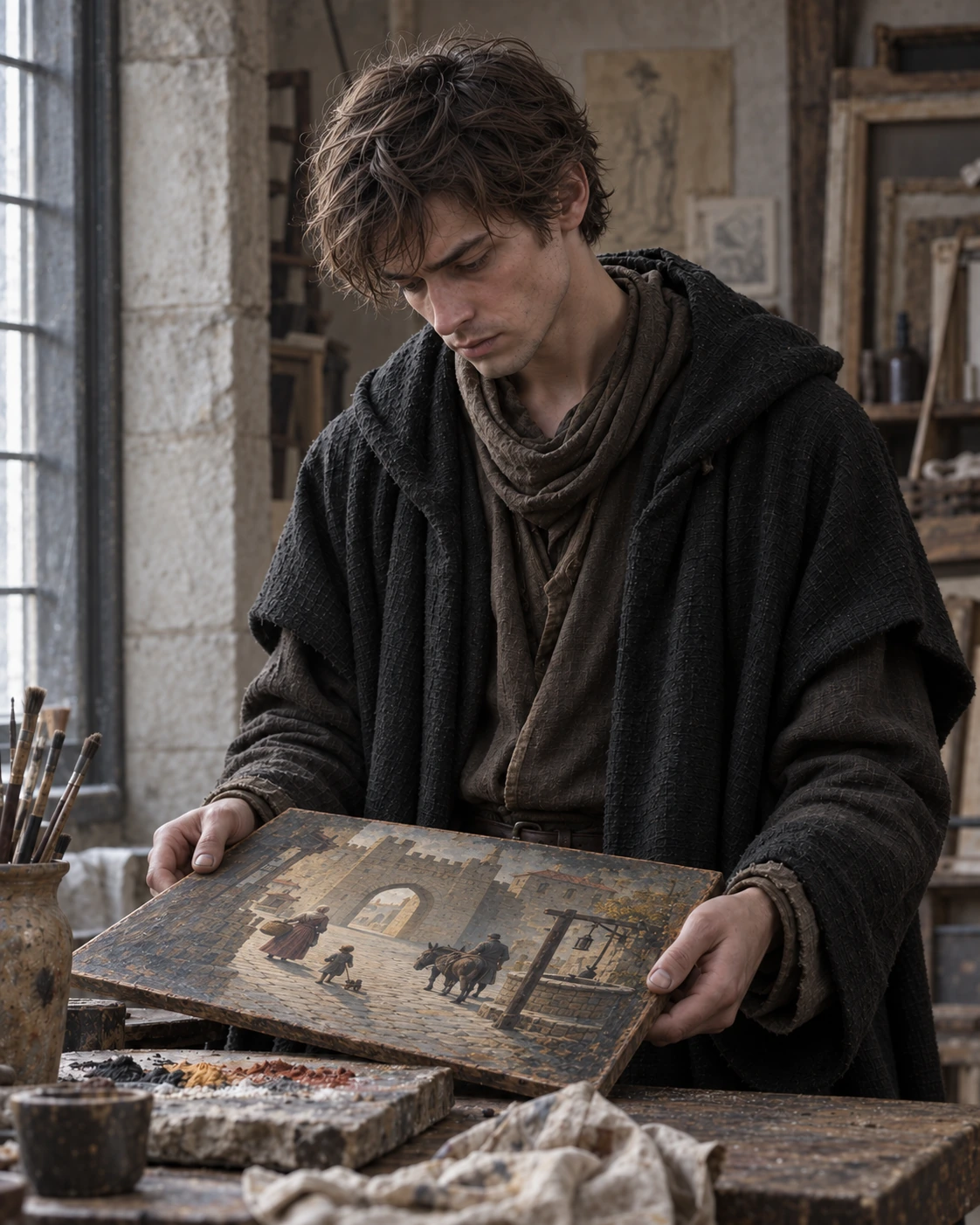
The gate still stood intact. There was no fire, no panic, no collapsing wall. A woman carried a basket, a child pulled a wooden toy, and a man led a donkey by the bridle. Saeron had captured an ordinary day so convincingly that Eiran almost put the painting aside without looking further.
Then he noticed the shadows.
The basket cast a shadow on the cobbles. So did the child. The donkey’s shadow stretched towards the well, and even the thin wooden post beside the wall had a shadow that matched the direction of the light.
Only the gate cast none.
Eiran brought the painting closer to the window.
He looked for an error in perspective, a place where Saeron had meant to lay down darker paint, or some simple inaccuracy left in an unfinished study.
He found nothing of the kind.
The gate stood in light that seemed to know what to do with everything else.
Eiran turned the panel over.
There was no date, signature or note. Only a dark smear left by a finger.
It could have been an experiment, a mistake or work left half-finished. Yet the longer he looked, the less he believed it was an accident.
Something knocked in the yard.
He lowered the panel and listened.
After a few seconds came another sound, quieter than the first. Metal touched stone.
He did not go straight to the window. He stood beside the frame and looked out at an angle.
A man stood against the opposite wall in a coat fastened high at the neck, too high for the mild weather. He was not looking at the studio. In fact, he was doing nothing.
That very inactivity caught Eiran’s attention.
A man waiting usually looked around, adjusted his clothes or shifted his weight from one foot to the other. This one scarcely moved.
A moment later a second man appeared at the entrance to the yard.
The first stayed against the opposite wall. The second headed for the studio entrance. A moment later a third appeared at the yard entrance and followed him.
Eiran stepped back from the window.
The bell of a city patrol sounded in the distance. Someone was closing a shop’s iron grille, and smoke from the evening fires gathered above the roofs. The city was moving into evening, unaware of what was happening in one of its studios.
Footsteps approached the door.
Eiran looked at the work laid out before him: the painted study of Meran, the picture of the gate, several sketches and a small notebook by the wall. He did not know what mattered. He was not even certain that the two paintings which had caught his attention meant anything at all.
The handle moved.
He decided at once.
He took the study of Meran and the picture of the gate, then slipped both panels into a canvas cover used to carry small works.
Metal scraped beyond the door.
He looked once more at the notebook. For a second he wanted to go back for it, but beyond it were sketches, samples and more drawers.
There was no time to choose twice.
Wood groaned under pressure.
Eiran ran towards the rear wall.
The low loading hatch was used to take frames and larger canvases out into the yard. For years Saeron had said it needed widening, then invariably found more important things to do.
Eiran slid back the bolt and pushed the cover outside.
Something cracked behind him.
The door gave way.
He squeezed sideways through the opening, catching his upper arm on the stone frame. Pain spread through his shoulder, but he did not slow. He seized the cover and pressed himself against the wall beneath the window.
Footsteps sounded in the studio.
They were unhurried.
That was more unsettling than haste.
One chest scraped across the floorboards, then another. A few words reached him, but the stone wall and the distance blurred their meaning.
Eiran moved behind a stack of empty frames and waited.
He heard paper rustle, a drawer open, another step.
After a moment one of the men spoke more clearly.
“Not here.”
A brief silence.
“Keep looking.”
Eiran did not know what they were looking for, and he had no intention of staying long enough to find out.
He pressed the cover against his side and moved along the wall, using the shadow of the next building. Only once he was through the yard entrance did he quicken his pace.
He ran into a narrow street between the houses. An open drain crossed the cobbles, the smell of hot tallow came from a nearby workshop, and damp washing hung from an upstairs window. Someone was carrying crates into the street and swore when Eiran almost ran into him.
He did not look back. The cover struck his hip with every step.
Only after the second crossing did he slow. He began to listen, trying to distinguish any possible pursuit from the ordinary sounds of the street.
He heard nothing suspicious.
Then he remembered Lira.
His relief died at once.
He quickened his pace.
He crossed the street, turned beside a house with a stone arcade and ran down a few shallow steps.
The stall where he had last seen her was empty.
He stopped so abruptly that the cover struck his ribs.
“Lira?”
She did not answer.
He went closer. He was certain of the place. The same piece of wood lay beside the wall, and one of the barrels stood a little farther from it than before.
He looked behind it.
No one.
“Lira!”
This time several people turned their heads, but he did not see her among them.
Farther along was a narrow passage between the buildings, barely a gap left between two walls. An adult would have had to turn sideways to squeeze through.
Eiran looked inside.
He saw only darkness and a patch of wet cobbles.
He called again.
No answer.
He stepped back into the street, trying to decide where the girl could have gone in her condition. He did not think she could have gone far.
Not alone.
That thought was worse than the last.
He had promised her he would come back.
He had come back.
Eiran looked behind him.
A man stood on the other side of the street.
He could not tell whether he had seen him before. When their eyes almost met, the stranger turned his head and walked slowly in the opposite direction.
He might have been an ordinary passer-by.
Eiran told himself he would come back and keep looking. First, though, he wanted to be sure no one was following him.
He moved on, holding the cover tight beneath his arm.
On one panel, Saeron had painted Meran’s wound in a way Eiran could no longer readily explain. On the other, an ordinary gate stood amid an ordinary day and alone cast no shadow.
Neither painting proved anything yet.
Both were enough to make the simplest explanations uncomfortable.
Eiran disappeared around the corner.
Only when his footsteps had faded did a scrap of dirty cloth stir deep in the gap between the buildings.
After a moment the darkness was still again.