

Elaris · Chapter IX
The Sky in the Crown
Your place and text size are remembered in this browser.
Scene I
Saeron moved the bowl towards the edge of the table. On the exposed wood he traced the line of the stairs with his finger, then lifted it where the plinth should begin. There was no room for the arch. He drew his hand back and tried again, fitting it into a smaller space.
His finger stopped above a knot in the wood.
In his memory, the statue now stood too close to the entrance. When he moved it further back, the stairs disappeared. The head remained, and the bright opening in the crown, so clear that the rest seemed something he had momentarily overlooked. He only needed to look from the side. He took half a step along the table, leaned over and only then lowered his hand.
He went over to the bed.
Light still came through the window, but the newer plaster opposite no longer stood out so clearly against the wall. Saeron sat down and tried to find the bend in its edge. After a while, the paler surface reminded him of a blank painting ground with only one edge marked out.
He turned his head towards the door. He could hear a conversation, too far away to make out the words. He waited for the footsteps to come closer. They passed his room.
He lay on his side with a hand beneath his cheek. The blanket chafed the skin beside his mouth; he moved it away a little and closed his eyes.
He tried to return to the place beneath the arch. The statue’s face changed whenever he studied it for a while, so he left it indistinct. Below were the hands. He could see the background through the spaces between the fingers. He remembered how deeply the stone had been cut away there and could follow the edge with his eyes all the way to the wrist.
A single voice sounded in the corridor.
Saeron opened his eyes. The plaster showed white before him.
He shifted his arm, which was beginning to go numb, and lowered his eyelids again. This time he stayed with one of the statue’s hands. He did not try to correct it. He waited for a length of blade to emerge from among the stone fingers.
He felt something cold beneath his cheek.
He moved his head away. He was sitting against a wall, his hand held beside his face. For a moment he kept it as it had been on the bed. Only then did he straighten his fingers and lay his palm on the ground.
Pale dust settled into the creases of his skin. He still remembered the rough blanket beside his mouth, but when he ran his tongue over his lip, he felt only its dryness.
A street ran before him.
He did not get up at once. He examined the stones at his feet. One slab was raised at a corner; fine grit had spilled out from beneath it. He reached out and touched the edge. Then he looked up at the wall he was leaning against and back down at his feet.
The slab was still in the same place.
He rose slowly. His knees had stiffened from sitting, though he did not know how long he had been there. Instinctively, he reached for support. The wall ended in a ragged edge just above his head. Further back, a much taller wall remained. Only now did he recognise the buried interior between them.
Beneath a surviving opening were two rows of sockets. A broken piece of a support protruded from one. Saeron tilted his head, trying to extend the line of the old ceiling in his mind. It ran high above him. Lower down he could see another row of openings, partly buried.
The house had more levels than he could make out from the street.
He moved back to take in its width. The wall stretched a long way, broken by vertical gaps. Some might have been windows. At others, the stone had broken away down to the base, and there was no telling where the old opening ended and the damage began. The highest surviving section remained out of sight until he tilted his head back.
He raised a hand to the back of his neck and looked along the street.
The buildings ahead obscured one another. From ground level he could see little more than their lower parts: the bases of pillars, dark entrances, stone that had fallen into the road. Only through a breach on the opposite side did he glimpse buildings higher up. They stood one behind another on the slope, until the small openings in their walls merged into uneven bands of shadow.
He picked out an entrance a few paces further on.
He walked towards it, avoiding the raised corner of the slab. At the threshold he stopped and looked back. He could see where he had been sitting, the pale debris at the foot of the wall and the grit beneath the stone. The distance matched the ground he had covered. He took a step back, then another.
He did not need to go back any further.
He turned towards the entrance. He loosened his grip on his clothes and this time crossed the threshold without hurry.
A broad strip of shadow lay just inside. The surviving section of ceiling covered only part of the interior; beyond it lay rubble, with light falling on it almost vertically. Where light met shadow, the small fragments had sharp, dark edges.
There was enough room to pass beside the wall. A broad band decorated its surface, distinctly smoother than the rest. From the street he had taken it for a stain. Now he saw traces of colour.
He went closer.
In two places the top layer had fallen away, exposing the pale ground beneath. Thin lines ran between them, broken by small gaps. Saeron stood sideways so that his shadow would not obscure the wall. Then he drew his head back. From that distance he could see only dark marks; he had to move closer again to see how they connected.
Several narrow lines intertwined inside a broader one.
He followed the band with his eyes. At the next damaged patch the pattern disappeared, then returned further on in the same arrangement. He remembered a similar interlace on the wall above the stone bench. Then, too, he had only seen it up close and had sat beneath it, where other people’s backs had worn the surface smooth.
He examined the ground. Here, fragments of the ceiling lay beside the wall. There was no bench.
He crouched beside the lower end of the decoration. More paint survived there, sheltered by a jutting stone. The lines were closer together than he remembered. For a while he followed one until it emerged from beneath another and disappeared into a crack.
He wiped his fingers on his clothes. He wanted to touch the place where the lines were most tightly interwoven, but stopped his hand just short of the surface. He followed the pattern again, noting which line lay on top. Then he stood and went back into the street.
Now he was looking for higher ground.
A narrow view of the slope opened between two walls. Saeron moved sideways, skirting rubble at the base of a pillar. Above the remains of the roofs he saw the upper part of an arch. One side disappeared behind a nearer building.
From here he could not judge the distance. He went further out, into the middle of the street, and looked for a road leading uphill.
The street rose gently between the walls until part of a collapsed upper floor blocked it. Saeron squeezed past beside the wall, his shoulder against the rough stone. Beyond the rubble he could see almost the whole arch.
Beneath it he could now make out the edge of a terrace. It ran horizontally above the roofs, broken in places by dark gaps. One pillar seemed wider than the other. Saeron moved to the left, trying to separate the overlapping surfaces, and only then saw that the street did not reach the slope.
He slowed.
Ahead, the paving ended in an uneven edge. Beyond lay a stretch of empty space and a wall on the far side, with more paving slabs showing white along its top.
Saeron went to where a low section of parapet remained. He rested a hand on it and looked down.
The canal was dry. Large pieces of broken stone lay at the bottom, partly buried in the same pale dust that covered the street. Flat, exposed strips stretched between them. Both banks were lined with masonry; a darker line ran along the opposite wall, disappearing beneath a fall of rubble. He could not tell whether it marked an old water level.
All that remained of the crossing was a stone projection on his side and a shorter one on the other. The gap between their broken ends was wider than he had first thought. Below, among the rubble, he recognised a fallen section of parapet. The groove along its side matched the one beneath his hand.
He drew his hand back.
To the left, the bank had collapsed. Part of the wall had fallen into the canal, forming a broad slope of stones and smaller rubble. Several large slabs lay at angles across one another; he might be able to climb down between them if he could find enough room for his feet.
He looked for a way out on the other side.
Opposite the fallen rubble, the wall rose unbroken. Only further along, to the right of the old crossing, did he see a row of short shadows. Steps ran up beside the wall towards the end of the street. A fallen slab hid the bottom steps. Above it, a narrow landing remained, followed by another flight turning towards the terrace.
He traced the route again: down on the left, across the canal bed, up the steps to the right of the broken crossing.
Then he looked beneath the arch.
There was a dark space between the pillars. From this distance he could not make out a plinth. If a statue stood there, he would have to go right up to the stairs to see the opening above its stone forehead.
He moved away from the edge and returned to the fallen rubble.
The first slab lay almost level. Further down, Saeron had to crouch; small stones slipped out from beneath his sole. He waited for them to settle and turned to face the slope. Holding on to the edge of the street, he lowered one leg. For a moment his weight pulled him down before his foot found support.
When he looked back towards the far bank, the arch was no longer visible.
Above the canal wall, only the pale sky remained. Saeron tilted his head back, trying to find at least the upper part of the structure. In that position he began to lose his footing. He drew himself back towards the rubble and went on down.
At the bottom he rested his hands on his knees. For a while he looked at the dust beside his boots. He was breathing louder than he wanted. Above him lay the slab from which he had just lowered his leg; from this side he could see an empty gap beneath it.
Rubble hid the steps on the far side. Saeron could see only the upper landing. He made his way towards it, skirting the broken stones. Beneath the old crossing, a huge block barred his way. He went round it on the open side of the canal bed and saw the landing again.
The slab covering the lower part of the stairs rested against the wall at one end, while the other was buried in small fragments. The edges of two steps rose above it. Saeron pressed his hand against the slab. It did not move, so he stepped onto its lower end. The stone beneath his boot was smoother than he expected. He braced his arm against the wall, swept the dust from the edge of the higher step and pulled himself up onto it. He sat for a moment, facing the canal.
From here he could see the whole slope he had climbed down. The broken road remained high on the other side, and the slabs overlapped so closely that he could barely pick out where he had put his feet.
Beyond the turn, the stairs narrowed between the wall and the surviving base of a pillar. Saeron held on to the base to lift his foot over a cracked step. Further up, the way was clear. He saw the edge of the arch, now so close that he had to raise his head.
Only a few steps remained before the terrace.
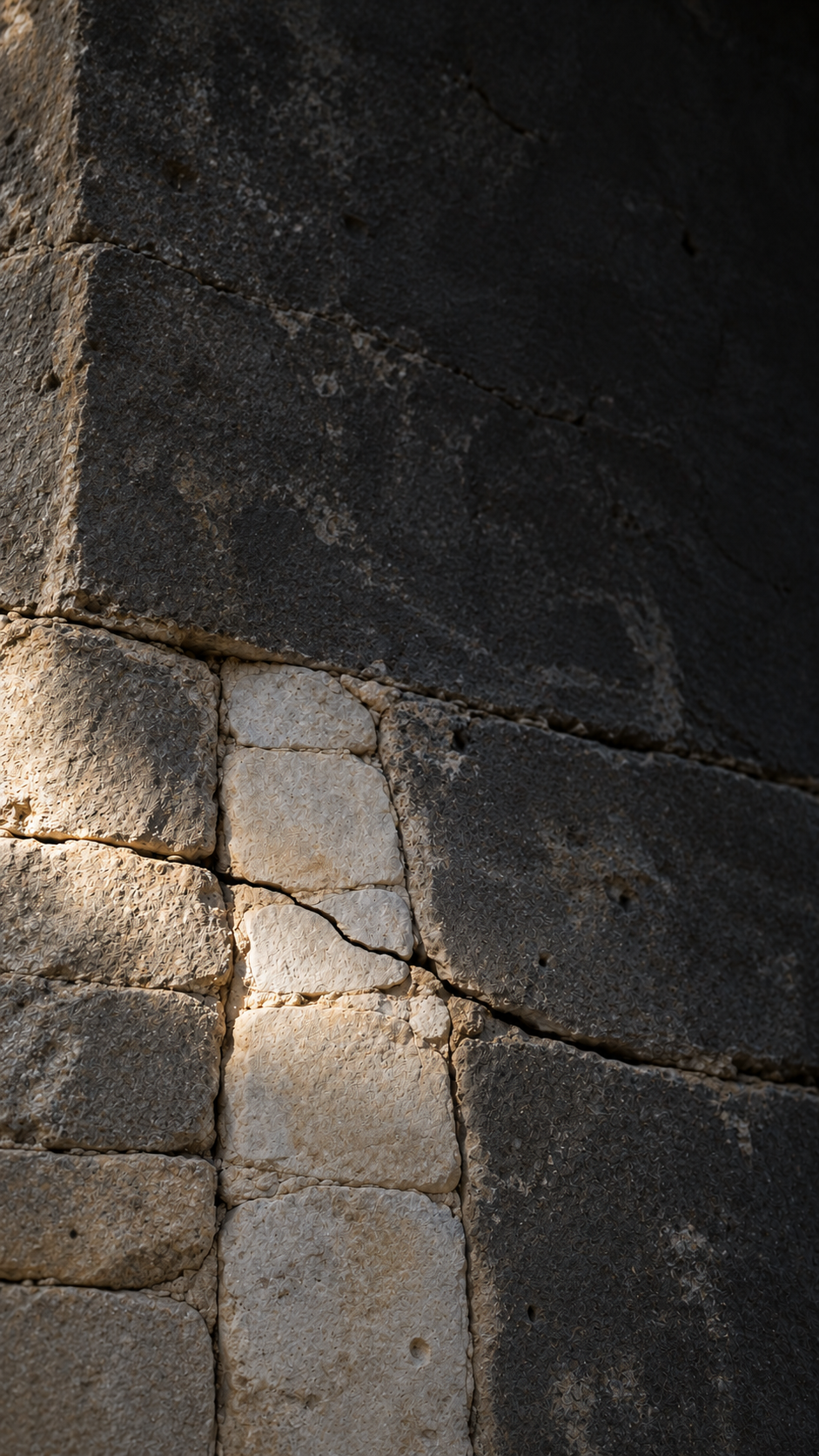
Above them stretched the massive stone side of a structure, the rest of it hidden behind a pillar. A narrow, paler strip had been fitted into it near the ground. From a distance it had looked like part of the decoration; only here did Saeron notice its irregular edges and the small pieces fitted around larger ones. Someone had been filling the gap with whatever they could set between the surviving edges.
A wide crack cut across the strip and continued through the darker stone.
A woman stood beside it.
Saeron stopped below her, his hand on the pillar. The part of her black robe visible beyond the stone moved as she bowed her head. She held one hand near the surface of the structure. For a moment he could not see what she was doing with her fingers.
He moved half a step.
She was touching the edge of the paler repair. Slowly she moved her hand towards the crack, but stopped short of it, beside a small piece set at an angle. When she drew her hand back, Saeron expected her to examine the crack as well. The woman kept her head bowed over the same spot.
A similar repair was visible higher up, broader and darker. The same crack ran through both. Saeron could make out the sequence of changes: first the fitted pieces, then the split running through the stone regardless of the old joints.
He wanted to come close enough to see a tool mark at the edge of the repair. The woman stood between him and that spot.
He stopped with his foot on the next step. He did not know how to speak to the woman without making her leave.
The woman slowly turned her head. Light moved along the pale edge of her mask. Saeron followed it as far as the temple, waiting to see whether even a sliver of her face would show beneath the metal.
The sky showed white through the crown. He remembered the same narrow opening above the statue’s stone forehead.
She stopped, facing him.
Saeron glanced behind him. The stairs were empty. When he looked at the woman again, he saw that she had raised a hand, her fingers barely clear of her robe.
“Who…”
Saeron waited for more. The rough surface of the pillar lay beneath his fingers. He moved his thumb across it without taking his eyes off the mask.
“Can you hear me?” Saeron asked.
“Yes.”
The answer came at once. Saeron lowered his hand.
“How did you get here?”
“Across the canal. The crossing was broken.”
“And into the city?”
He looked down the stairs. From this side he could not see the street where he had come to. But he remembered the raised corner of the slab and the wall behind his back.
“I don’t know. I found myself beside a wall.”
The woman lowered her raised hand.
“What were you doing before that?”
“Lying in my room. With my eyes closed.”
Her masked head tilted back a little. He could not tell whether she was looking at him or at the empty space beside him. He waited, but she asked no further question.
“Do you know this place?”
“Yes.”
Saeron looked at the crack. It seemed wide enough to put his fingers into.
“Were you here before this happened?”
“I knew this city before the buildings fell.”
He looked at the ruins behind her. A window opening remained intact in one wall, but there was no longer a room on the other side. He wanted to see those walls as she remembered them.
“What destroyed them?”
The hand she had used to touch the repair came to rest on a fold of her robe.
“I won’t speak of that.”
Saeron closed his mouth. He wanted to ask why, but stopped short of saying it. He did not even know her name.
He looked at the small piece of stone where her fingers had stopped earlier. From below, it was almost indistinguishable from the rest of the repair.
A key scraped in the corridor.
Saeron turned his head. The stairs behind him were empty, but he heard a vessel being moved across wood.
“Water.”
He looked back towards the woman. Her dark robe merged with the shadow of the structure. For a moment he could still see the pale edge of her mask.
He tried to set his foot higher.
His knee pressed into the bed.
Scene II
He opened his eyes.
The guard stood at the table. He had put down the bowl and was reaching for the jug. Saeron raised his head; the blanket slipped from his cheek.
“What?”
“I’ll top up your water.”
The man lifted the jug. At the door he had to step aside for another man waiting with a bucket. Saeron sat up. He heard water striking the bottom, then a fuller sound as the jug began to fill.
A moment ago the woman had been facing him. He did not know whether she was still standing there.
The guard brought the jug in and set it beside the bowl. He looked over the table, then the bed. Saeron’s mouth was open.
“What do you want?”
He shook his head.
The man went out. Once the door had closed, Saeron waited for the footsteps to recede from his room. Only then did he lie down again, just as before, with his hand beneath his cheek.
He closed his eyes.
He felt the pressure of the blanket more clearly now. He tried to recreate the stairs, but whenever his memory reached the place beside the pillar, the woman was already facing him. He could not recover the moment when she had been examining the repair and had not yet noticed him.
He opened his eyes. The newer plaster showed white on the wall.
He had told her about the room. About lying with his eyes closed. He could have added where he was, asked her to find someone at court. While asking about the ruins, he had not even thought of it.
He did not know why she would help him.
He went to the table and poured water into the cup. He drank a few mouthfuls, then set it down.
If he heard her again, he would ask her name first. Then about that small repair he could barely see from below. He wanted to know why she had stopped at that particular spot.
He returned to the bed. This time, as he closed his eyes, he tried to remember her voice.